Control systems · 2026
Wind turbine pitch control
Modeling a variable-speed wind turbine. Designing feedback that brings its response under control.
01 / CONTEXT
The challenge.
A wind turbine needs a controlled pitch response as operating conditions change. A poorly damped response can overshoot and take too long to settle.
02 / PROCESS
The approach.
- Model the pitch actuator and drivetrain with inner and outer unity feedback; derive H(s) = 50 / (s³ + 7.5s² + 12.5s + 50).
- Analyze the original system using step response, symbolic time-domain expressions, Bode plots, Routh–Hurwitz, and root locus.
- Compare gain compensation, phase-lead, phase-lag, and Ziegler–Nichols PID designs using transient performance and stability margins.
- Document design trade-offs, including the difference between the requested 80° phase margin and the achieved values.
03 / REFLECTION
The outcome.
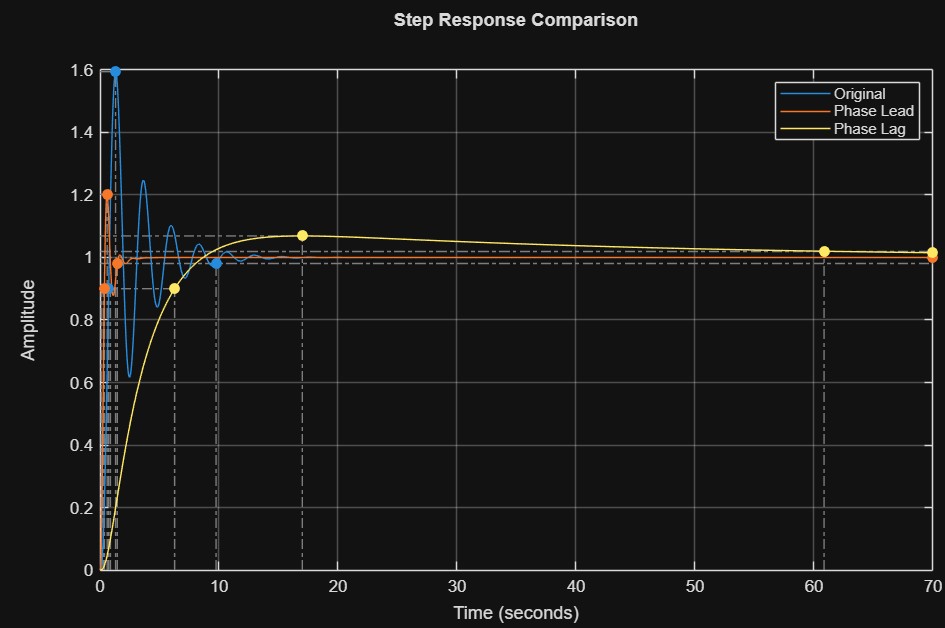
In MATLAB simulation, lead compensation reduced settling time from 9.757 s to 1.4587 s and overshoot from 59.428% to 20.252%. Lag compensation reduced overshoot further, with a 60.843 s settling time. The Ziegler–Nichols PID settled in 5.142 s.
| Design | Settling time (s) | Overshoot (%) | Phase margin (°) |
|---|---|---|---|
| Original | 9.757 | 59.428 | 18.078 |
| Gain compensation | 7.234 | 45.087 | 28.1 |
| Phase lead | 1.4587 | 20.252 | 44.331 |
| Phase lag | 60.843 | 6.8876 | 75.253 |
| PID (ZN) | 5.142 | 59.547 | 24.8 |
Project scope
Simulation study using a linear actuator and drivetrain model. The lead design achieved a 44.331° phase margin against an 80° target. Team: Alazar Wake, Mahteb Negussie, Nahom Megerssa, and Yetemegeta Sebisbe.
04 / RESOURCES